The Template for a Museum
Wandering from the train station into Pollok Country Park not far from the centre of Glasgow, I switched off the map on my phone and relied instead on my general sense of direction as I moved toward the Burrell Museum. It would miss the point entirely to be constantly looking down at an electronic device here. Being slightly lost on the paths of this beautiful woodland park in late Autumn with warm orange, red and yellow leaves underfoot was no bad thing. Outside of the city's stone buildings, busy streets and grey skies, the colours, sounds and fragrances of the park were completely different.
An avenue of trees suddenly straight and orderly defined another path at the edge of the wood. Although tempted to change course, I continued winding my way through its middle, at a remove from the city, until arriving at an enormous clearing, a grassy field. Here was the Burrell Museum, low slung and holding one corner of the open space, appearing modest rather than grandiose. Anchoring sandstone walls gave way to what seemed like glass garden conservatory roofs. Part of the collection, an historic stone arch, had been repurposed as an entry portal embedded into the contrasting red hued sandstone.
For many years there has been a convention in the design of art museums that gallery spaces need to be neutral, flexible and in no way should compete with the art contained within - the classic white box. The exuberant exterior of a museum specifically designed to respond to context and represent the idea of a museum in some way could become completely detached from its interior gallery spaces, which then acted as neutral backdrops, almost formulaic in character. The Burrell Museum challenges that approach, and by doing so creates a wonderful connection between the collection and the place surrounding it, in particular nature.
The original design was the outcome of a competition in 1970, and won by three architectural tutors from Cambridge University - Barry Gasson, John Meunier and Brit Andresen (who later co-founded the highly influential practice Andresen O'Gorman in Australia). Their scheme for the museum took a long time to realise, as these things can do, with more funding inevitably needed and eventually opening its doors in 1983. More recently, John McAslan + Partners completed a thorough refurbishment, sensitively repairing and upgrading the building envelope for the most part, but also incorporating a new open internal amphitheatre to replace an original closed lecture theatre. My visit was about two years since its reopening and I had not been before, so I could not compare to the original. To me, the building felt like it remained true to the vision that won the competition.
The first impression, having ducked inside through the stone arch, was of the natural materiality of sandstone (its continuity from outside creating a strong cohesion with the interior) and timber (expressed in structure and linings). The same stone is much used in historic Glasgow, and so reminds us that this is still a public building and part of the city, despite its immediate surroundings. A sequence of spaces alternating between the dimly and the brightly lit, eventually opened up into a sunlit internal court, that intuitively draws visitors through. Another historic stone archway, reconstituted on the arrival axis, marked the threshold into the gallery proper.
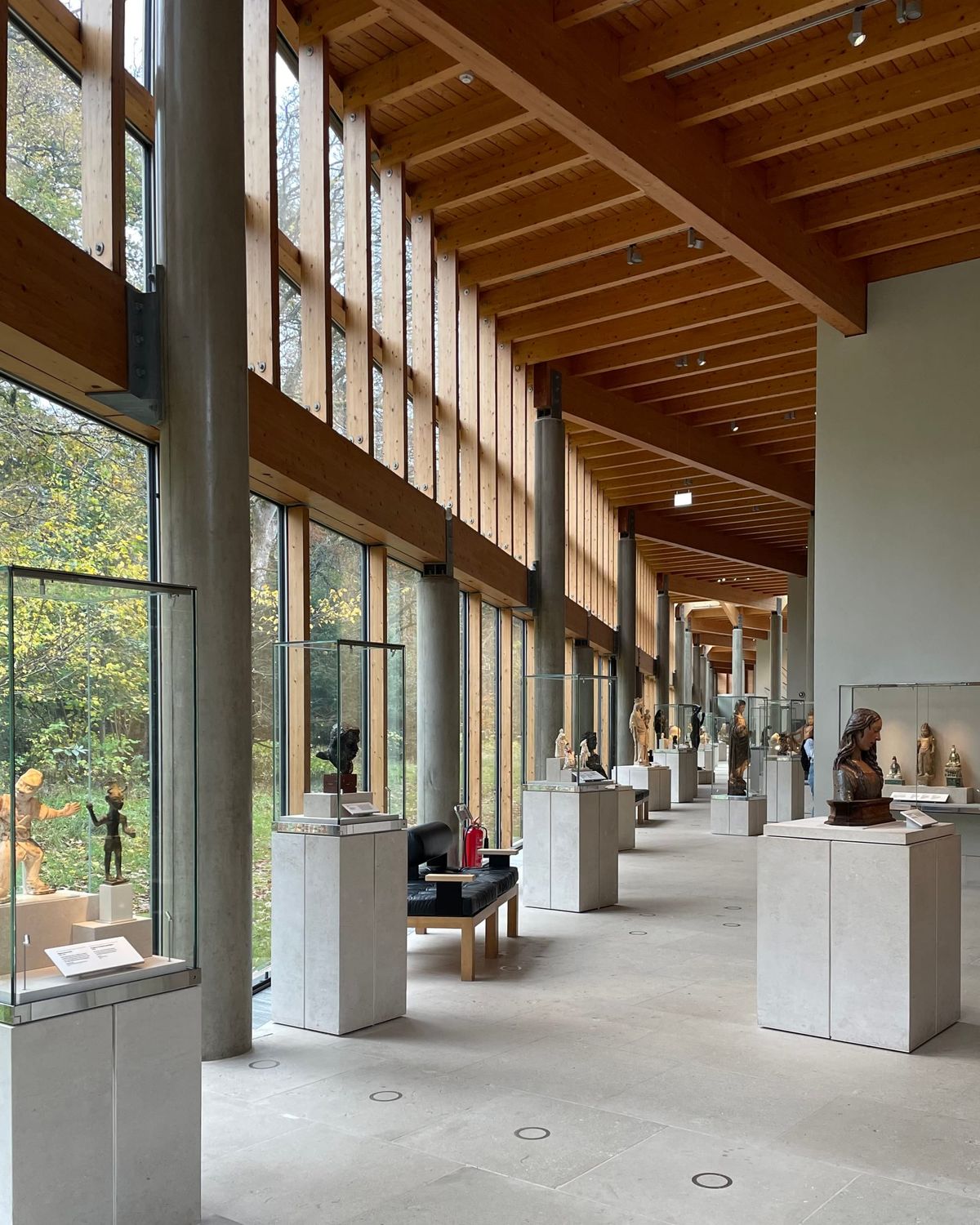
And once across that threshold I could see the key ordering idea of the museum. The entire northern edge of the museum was a glass wall, only metres away from a woodland of chestnut and sycamore trees. A museum sliced open to nature. The space was narrow, almost like a verandah, with its repetitive timber structure defining an easy rhythm. The slender, circular concrete columns made sense here, like the trunks of trees beyond. Diffuse light filters in through branches and leaves to illuminate sculptures, busts and historical fragments. It was an incredibly affecting space, an idea present from the competition scheme about establishing a 'walk in the woods' as the main way to orient yourself, and also to encourage contemplation of art in the context of the natural world.
The shipping magnate William Burrell assembled his eclectic collection of Chinese, Egyptian, Islamic and medieval works in the early twentieth century. There were intricate tapestries, patterned ceramics, stained glass, and the occasional, requisite salon hang of oil paintings. The collection appeared to have been curated thematically rather than historically, often using colour, pattern, and format to bring works together. As I explored the side streets of circulation found off that northern woodland edge, more discrete gallery chambers with tall timber ceilings could be found. Always, a glimpse back to the north along circulation routes helped to gauge where you were.
The scale of the galleries accommodated people well, they seemed to encourage you to sit and contemplate. Whilst this was clearly a public building there was also a domestic quality, an inviting character, that made me linger and absorb the work better. In fact, some of the galleries flanking the arrival court are modelled on rooms in Burrell's house where work was first on display, a more overt nod to that scale. Elsewhere, that character of a residence was more abstracted and subtle, evident in material, light and inviting proportions.
When hunger pangs arrived, I discovered a canteen slung below timber framed conservatory glazing with an outlook on to the open field. This contrast was no doubt deliberate, between the close, shaded woodland and the sunny, vast expanse of the clearing within it. It was a good place to recharge the batteries of attention before exploring further. It also gave me a moment to consider how enjoyable it was to experience a museum that intentionally dissolved the distinction between its outer and inner worlds, that allowed for art works to sit alongside nature, that was modest, inviting and almost domestic in scale, and that side-stepped the now conventional wisdom of the white box. A better template for an art museum would be difficult to find.