The Accidental Luthier
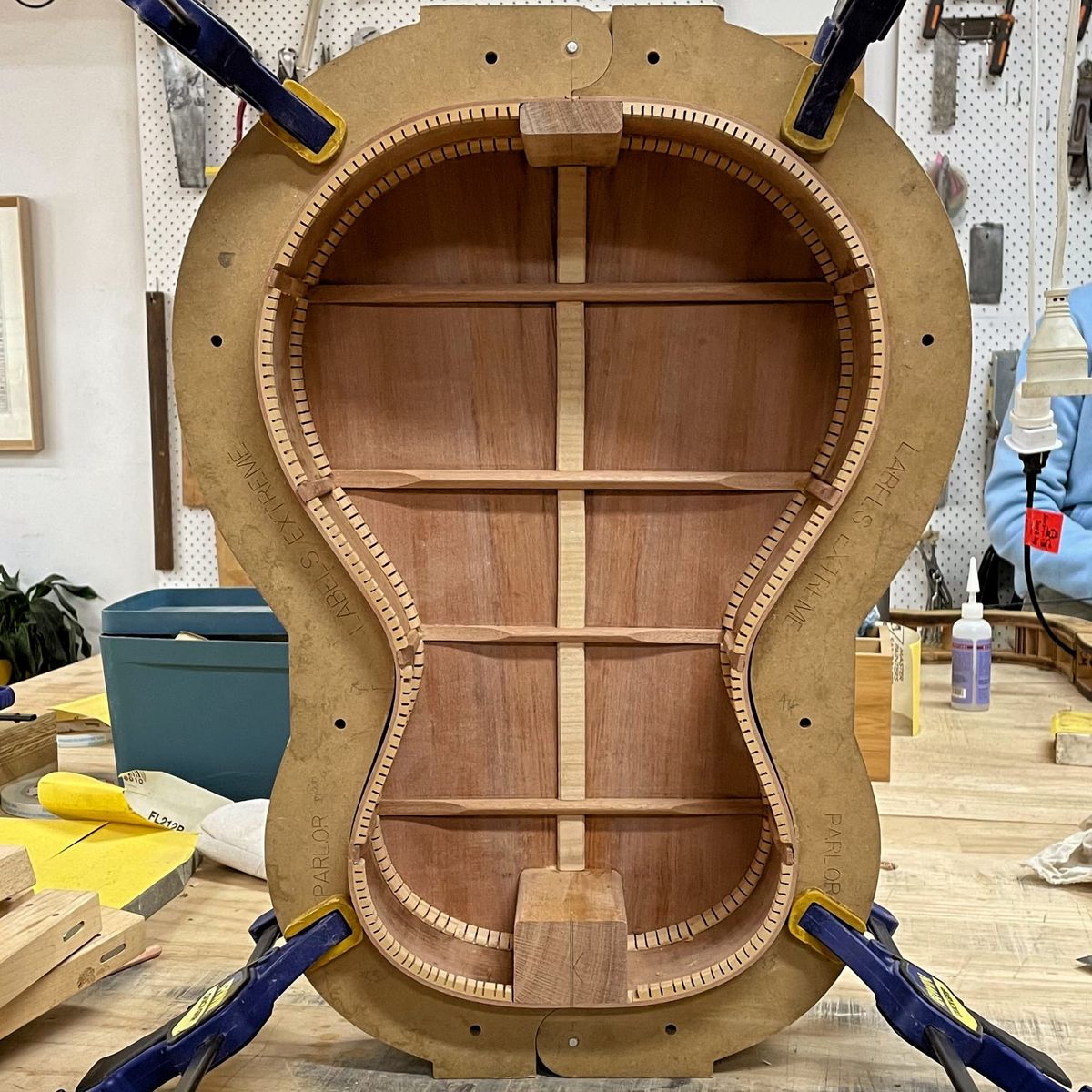
My first day in the workshop did not go so well. I quickly learnt that the ever-present sawdust was going to irritate my airways and cause my asthma to flare. The dream of opening my own little workshop turning out hand made instruments quickly became a chimera. I retreated to the hardware store and bought a heavy duty face mask with filters.
I soon met my fellow guitar makers, all at different stages of completion and with varying abilities on the tools. A former boat builder who told stories of piecing together timber hulls on the waterfront, and was expert with a scraper in hand. A laboratory chemist, she worked slowly and methodically, measuring precisely. A software engineer building a dreadnought guitar for his son to play, literally a labour of love with beautiful inlays. A young tinkerer, whose father was a well known local musician still playing around the traps, attempting a hollow body electric. Then there was me, an architect suddenly with some time on his hands, wondering if it was even possible to build your own guitar.
My first decision, a daunting one, was the selection of tone woods. From a stack of boards organised into various species, I rummaged through. Blackwood is beautiful, but I had read that it can affect those who suffer from allergies. Blackheart Sassafras has a dramatic contrasting grain, perhaps a bit too flamboyant for me. Eventually, for the back and sides Tasmanian Myrtle*. It has a lovely red brown colour and is meant to be warm and woody in tone, a little like traditional Mahogany. For the soundboard, shuffling through timbers I came across all of the pines (King Billy Pine, Huon Pine, Bunya Pine), soft and springy to provide more resonance when compared to the greater stability necessary for the back and sides. Then a Queensland Kauri that seemed to pair well with the Myrtle appeared, and the decision was made. Although the specific provenance of the timbers was unclear, they are often salvaged from old factory structures or at least sourced through 'responsible forestry practices'. The latter makes me slightly uneasy, as this might still mean selective logging old growth trees. I would have liked to have known more about the specific tone woods I chose but it was not possible
The workshop is on the main street of Kilmore, an hour's train ride from the centre of Melbourne. The township itself still has the remnants of its gold rush heyday architecture imposed upon the lands of the Taungurung peoples of the Kulin Nation. The old asymmetrical red brick police barracks designed by HR Bastow a prominent nineteenth century government architect. A masonic hall down a side street with an unusually crafted and delicate brick fringe, surrounded by temporary fencing and now looking a little lost. The grand facade of the Kilmore Town Hall, with its creamy cement render, the machinations of municipal politics long ago replaced by a succession of nondescript commercial tenants.
In the centre of town, in a shopfront that was once the Hall of Commerce is a tall-ceilinged space, generously proportioned, and now home to a bustling cafe where many in the town seemed to buy their first coffee of the day. Most mornings I would meet the luthier running the workshop here. We'd talk about music, a smattering of politics (this was during the last year of Joe Biden's presidency, and the reemergence of Trump), and family.
Walking in to the workshop, mask on, picking up where I had left off. Unfolding a large paper print of the guitar template I am working with. It is based upon a Martin 0-12, an early twentieth century model, a small parlour size with only 12 frets to the body. It is perfect for fingerpicking playing style, something that I enjoy. The drawing is very architectural, an advantage for me as I try to decipher geometry, bracing patterns and dimensions. I decide to attempt the slotted headstock you would find on the original rather than a simpler solid paddle. The guitar design to some degree is a hybrid as I need to use the workshop's parlour guitar moulds which are not exactly the same as the template. I figure this will make it a unique piece!
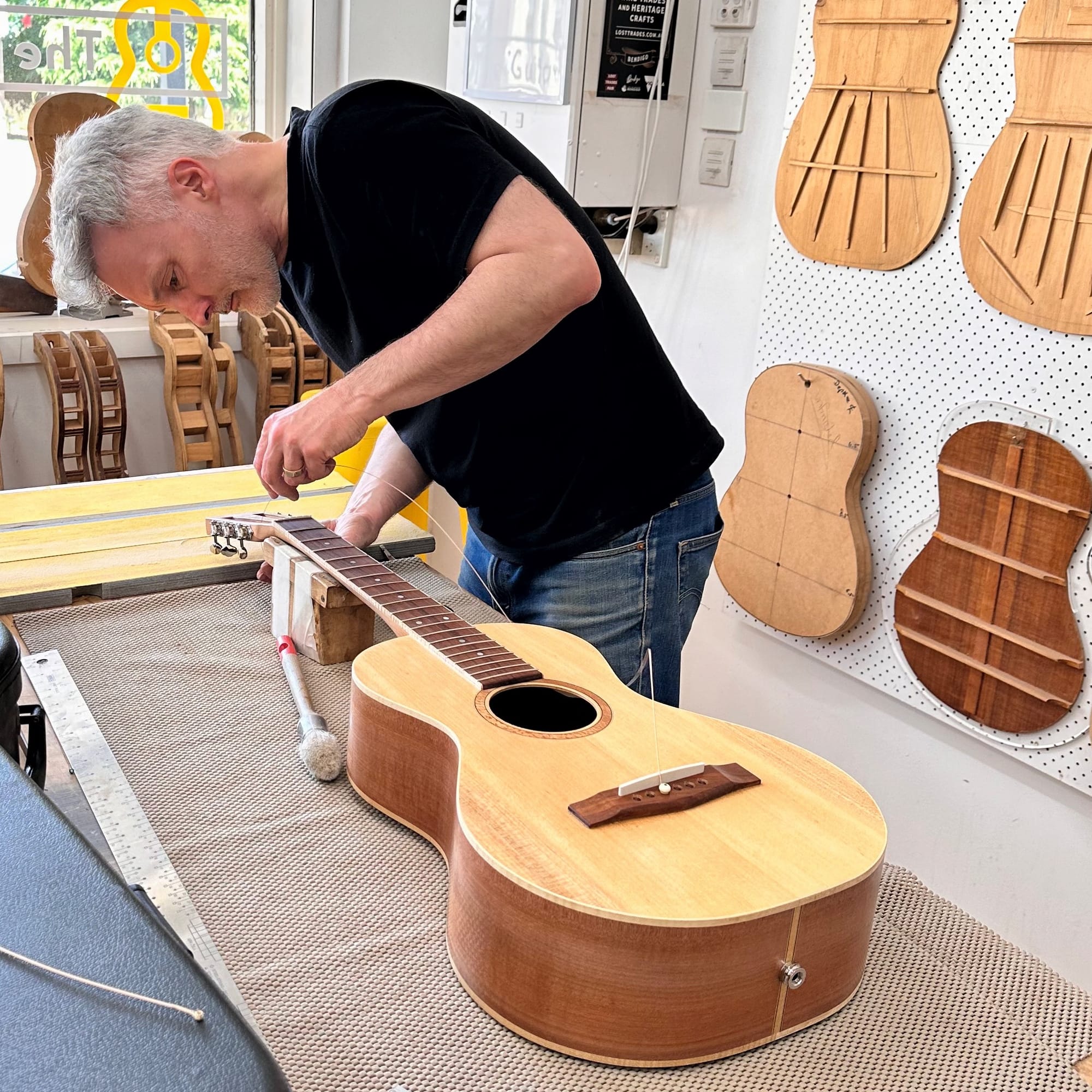
The construction of an instrument is steeped in tradition, ideas tested and honed over time, faith in techniques tried and true, dipping in to an established canon of knowledge. At the same time it can be very scientific, measuring resonance, examining string vibration, and introducing exotic materials like carbon fibre reinforcement. In the workshop, it is incredibly physical, discovering how particular tools work, a hand plane to find the shape of the neck, a finger plane on the bracing, using your eye to judge where it is just right. You start with simple pieces of timber, rectangular blanks, and keep removing excess until they start to resemble components of the guitar. It can be nerve-wracking - have I taken off too much? Gluing is the point of no return, where it can be both incredibly stressful and rewarding at the same time as the true form of the guitar emerges. Overseeing every step is the luthier, who explains everything one-on-one, taking me through the techniques and showing me the process. He is the coach, patient (mostly), encouraging (always) and a troubleshooter (when things inevitably go wrong).
After many months more than first thought, the final day in the workshop is here. Armed with a set of strings, I arrive excited and a little sad this will be it. The guitar needs some last adjustments to set up properly, the truss rod tightened a little, the bridge saddle sanded a fraction. As I wind the strings on, there is a slight fear that something will break or it won't stay in tune - how could this possibly have worked? When anyone finishes in the workshop there is a real buzz in the air. All the makers have supported each other, and it is a delight to see a guitar completed and hear it played for the first time. Once I have strung up my guitar I try the first chord and it sounds incredible, in tune with a punchy, woody sound from such a small body. I hand the instrument around for others to try, and I can't stop smiling. It feels like it is an amalgam of my efforts, the luthier's expertise, and the workshop crew's camaraderie. I say my goodbyes and leave everyone to continue with their own creations, knowing that the experience of making, together with others, will stay with me for a long time.
*According to Andrew Darby in his book 'The Ancients' - "Myrtle is present at the heart of Tasmanian forests, systems that have shown an extraordinary ability to survive on this island through millions of years. In this way, it might be called a Mother Tree. It is home to birds, mammals and frogs; it offers its canopy for insects and snails, centipedes and spiders. It is a companion of many other tree species, a perch for ferns, a protector of moss floors. It is rich in root connections to fungi." p.218