The Detached Artificial Eye
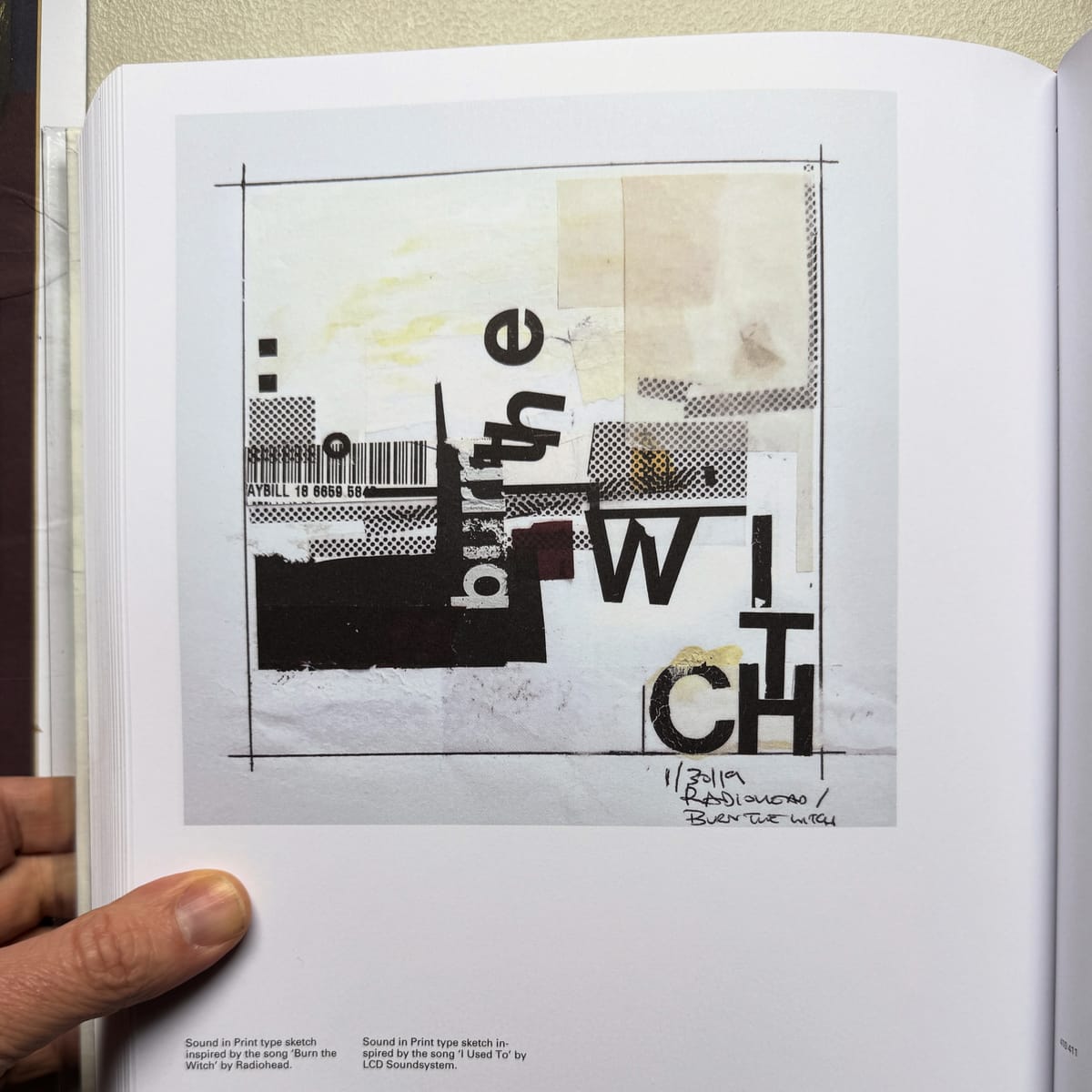
I recently came across the graphic design work of Chris Ashworth in his book 'Disorder Swiss Grit Vol. II'. It combines the perfectly composed, slightly off kilter, arrangements of the mid-century Swiss Style with an eye for layers, texture and the hand made. The invisible organising grid of the original design movement is respected but also eroded and disobeyed. Ashworth works both with and against precision, scratching away at it or overlaying other pieces to obscure it, and in so doing a very analog character emerges, warming up the cool underlying compositional strategies. He uses digital tools but still mostly works by hand with Letraset, sticky tape, liquid paper, glue and photographs. By incorporating what might be seen as purposeful flaws or glitches, Ashworth reminds us that the work is human. In the digital age of endless simulacra this is important.
It feels very different to the current tools of artificial intelligence that we are all grappling with. Large language models have been described by Emily Bender, a scholar of computational linguistics at the University of Washington, as conversation simulators, or synthetic text extruding machines. Essentially, she argues that they are merely word predictors. In a similar way, their graphic counterparts are trained on internet images to again predict what we might expect to see from what has been before.
You might argue that this mimics what people do when they create something. They utilise their combined knowledge of past works and ideas to propose a possible future. Although, when a person does it there is a human filter with all of its own idiosyncracies, its individual interests, values and drives. At some point a person will make a creative leap, initiated by process or intuition, that leads to something else.
Currently, artificial intelligence seems to be a very good tool for testing combinations of words or images (so potentially quite helpful in supporting a process). It has consumed more words and images than anyone on the planet could possibly absorb by themselves. So, the weight of probability means that artificial intelligence might even get close to replicating a form of combined knowledge after digesting all of that information (or equally it might replicate a collective stupidity or worse, if we are not careful).
However, a creative process generally still needs a human filter, the judgement about what is needed, an empathy for place and context, the recognition of a good idea. I can imagine AI being able to reproduce a Swiss Style poster for a 1960's jazz gig quite convincingly, after being trained on the historic data. However, could AI then use it as a stepping stone to something like Chris Ashworth's work? Can a series of prompts replace the process of composing by hand and eye, of testing ideas through conversation and debate?
For a while now, the internet has pooled images (rather than experiences) into a single morass. Now, the image and text extruding machines are replicating it, smoothing out the idiosyncrasies and the unpredictable quirks. There are exceptions but mostly there is a certain sameness as the outcome constantly converges on the most likely response to a prompt, and dilutes any inherent meaning. The most interesting outputs are those where the digested content is hybridised to the point where it reaches the uncanny valley of an image (or a text) that is both highly convincing and oddly unnerving. They reveal a slightly detached artificial eye.
All that said, AI is really just a tool, like any other. It can help to do some things more quickly, like testing many variations on a theme. Its hallucinations might even be helpful conversation starters. And yet, I'd still argue that the best design process is organic, one that engages both our senses and our human intelligence. Instead of emerging from a black box, it is transparent and can be discussed, critiqued and revised. It starts with keen observations and then responds playfully, or carefully or even wilfully. It has absorbed some lessons from history, but in digestible portions. It may be painterly rather than prescriptive. It can include found objects and adapt to them. In the end, it might even contain glitches, and reveal imperfections.