Imperfect Complexity
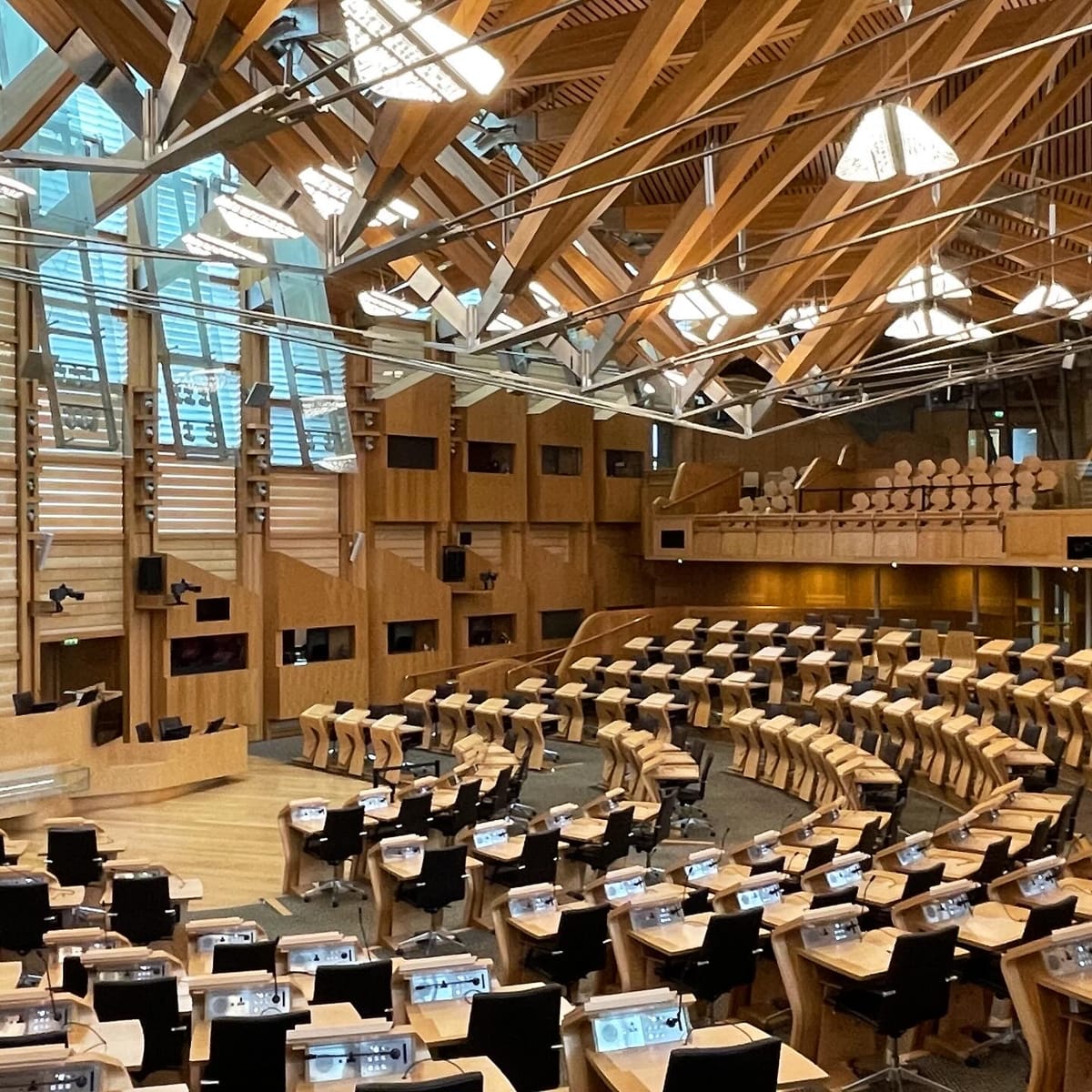
It was around twenty years ago that I read about the completed design of the new Scottish Parliament in Edinburgh, designed by Enric Miralles and Benedetta Tagliabue. It was not a monumental expression of a government's power, but instead more like a village accommodating to its context, the nearby hilly Scottish landscape and the processional Royal Mile.
I finally visited the building in 2024 just before the US election of that year, and the possibility that democracy was on the line was definitely in the air. At the Scottish Parliament itself, under a slate grey sky, the human hand was evident everywhere, from the Canongate wall outside with its embedded public artwork, to crafted boat-like interior spaces, idiosyncratic window compositions and the soaring timber-ribbed debating chamber. It was painterly in its conception, both complex and in some ways imperfect too.
Those imperfections left an impression - where forms intersected a little awkwardly, or circulation spaces were more convoluted. They were highly resolved but there was an acceptance that these moments in the building were also important to retain, keeping the wrinkles rather than ironing them out. It felt like an empathetic expression of the messy nature of democracy, recognising that its vitality was rooted in the gathering of different voices and their contradictions. The informal encounters happening in those wrinkly in-between spaces surrounding the bravura debating chamber were equally important to the back-room negotiation and compromises of government.
Where are we now with such complexity in architecture?
On one hand, digital tools allow for smoothing the geometry of spaces, to remove discontinuities and those curious wrinkles. Complexity has been made frictionless, in the same way social media aims to retain our attention by removing impediments to our focus. In contrast, perhaps there is also emerging a desire for the greater stability of whole forms and singular materiality. Complexity is found in the way familiar architectural tropes, like a shed form for example, are skewed or composed slightly off kilter. Informed by the need to minimise the carbon emissions of construction, rising construction costs after a global pandemic and a crisis in the affordability of necessities like housing, it appears that architecture is becoming more reductive and distilled.
The construction industry is also adopting more efficient ways to deliver buildings, particularly at the larger scale. Off site fabrication of building components that are then assembled on site is increasingly the preferred approach. It can save time, improve quality control and reduce carbon emissions. Individual craft is replaced by systems of repetition. In these instances, an interest in craft migrates by necessity from the singular to the multiple parts being assembled, their patterns, texture, colour and junctions. Complexity is displaced from site to the factory.
To limit our impact on climate change we are reusing old buildings more. There are found conditions to assess, to plan around and to integrate new fabric with. Layers of history resonate differently as part of contemporary architecture. The old crafts of a Flemish bond brick wall, a carefully riveted steel truss, or a cast concrete stair adjacent to lightweight modules and high performance glazing - it makes for a readymade delightful complexity. This all might sound like traditional skills are lost, but they can still emerge though usually in small gems, a house or a pavilion, in places where the tactile character is close to the inhabitant and the scale is manageable.
Much has been said about the fact that we need to continue building to house people and replace old structures that are no longer suitable whilst also minimising construction's impact on the environment and climate. There is an unresolvable tension between new construction and carbon emissions. To even consider building, we need to embrace lean design, to be materially efficient and inventive. This is not to suggest that architecture finds itself completely overtaken by engineering, measurement and data. Rather, it will find joy in doing the most with the least.
In a time when complexity is all around us, do we need spaces that reflect this situation, engage with it directly or act as a counterpoint? It felt like the Scottish Parliament was complex for a good reason, to foster a healthy democracy. Yet, the now constant background noise of technology, politics, climate and culture might also ask for a more reductive approach, that engages our senses but quietens the chatter. It is not all that exciting to talk about constraints, but they can be productive, and lead to new ideas. A more collective idea of restraint, of responsibility to the planet, is already upon us.