An Incomplete Survey
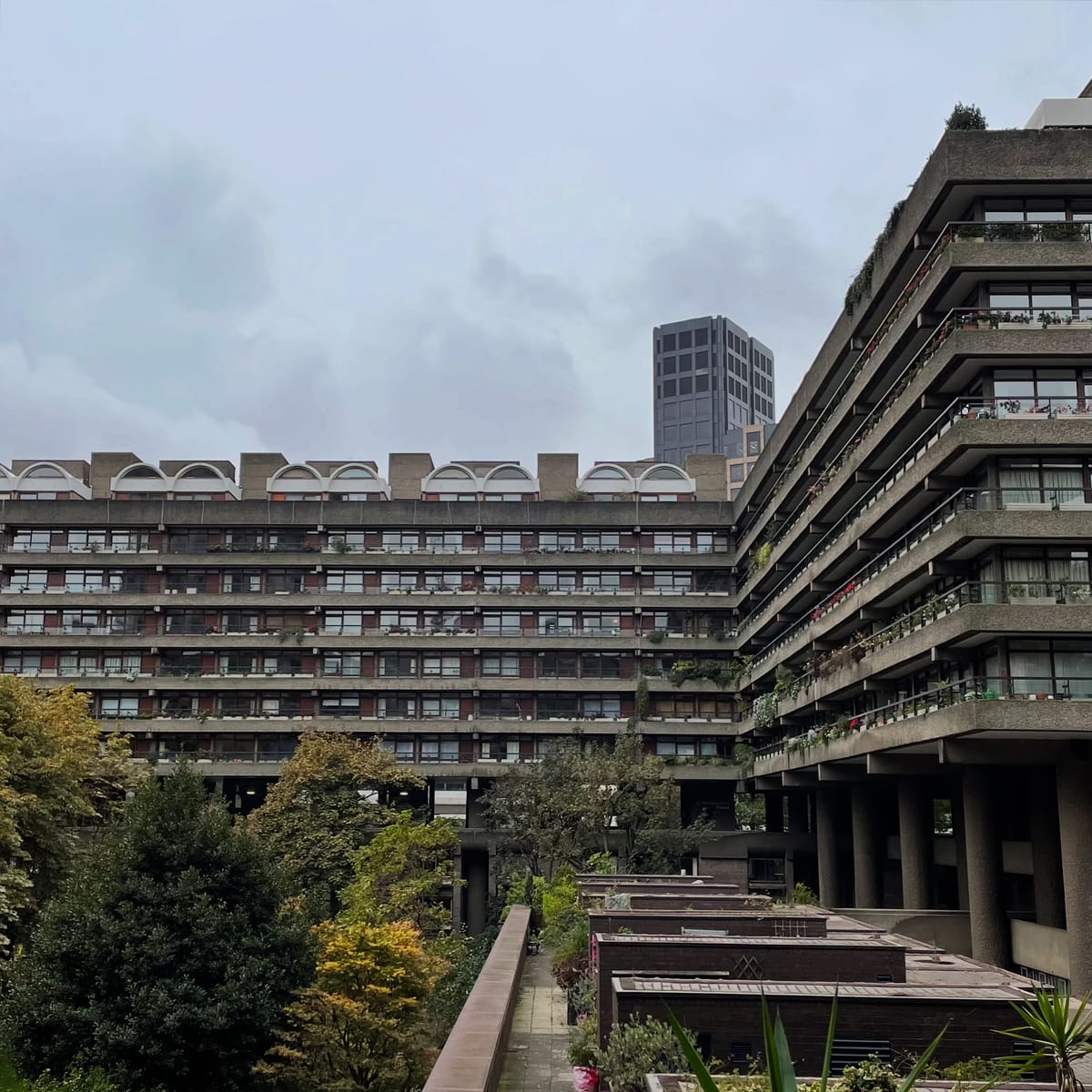
A recent trip to the United Kingdom allowed me to see some recent, and not-so-recent, examples of housing. An incomplete survey, as it was limited to what was close at hand, and of course it is almost impossible to see inside unless you know a resident. That said, it did allow me to reflect upon the relationship of housing to the street, to the individual and to the city.
Back in 2010, under the auspices of mayor Boris Johnson, the now superseded London Housing Design Guide established a range of design standards with particular emphasis on the sanctity of the street, defined by a continuous urban fabric with minor variations similar to what you might find from the Georgian period. It prioritised a 'background architecture' over the 'iconic' landmark, 'durable' materials and was not shy in aiming for a 'new London vernacular'. Wandering around London fourteen years later, it was evident that those policies had taken effect.
The emphasis on the street wall, adding patches incrementally to the urban quilt, is a reasonable starting point for a cohesive city. Around London, durability has most commonly been interpreted as brickwork in a thin veneer. Fading into the background means a mostly unadventurous and anonymous composition of windows. The new London vernacular is not offensive to the eye but it doesn't exactly create delight. It has been described disparagingly by Peter Cook, of Archigram fame, as being designed by the "beige and banal biscuit boys". Indeed, inventiveness is often replaced by a dogged consistency and conservatism. However, there were one or two examples I saw where an unusual brick choice and a carefully considered detail caught my eye and lifted them above the middling pack.
So, it was somewhat of a relief to find Cadence apartments designed by the architect Alison Brooks and located within the new Kings Cross development. It has the advantage of being an island site partly situated at the end of a linear park, allowing a more sculptural form rather than the two dimensional facade play typical of the new London vernacular pattern book. Two towers, twelve & sixteen storeys in height, are offset above a perimeter block with a shared, private central courtyard. The taller one aligns with the park like the campanile in an Italian city, a pleasing landmark. In addition to the 103 market sale apartments, 60 in the lower levels are designated affordable. Buyers for these must be local, a middle income earner and first time buyer, and they are offered at 20% below market value. No doubt it is still expensive, but this is still a worthwhile model.
The striking red brick facade is also a thin veneer, but employed in a robust way that creates depth and playfulness with bouncy arch motifs (using a Bezier geometry to be precise) and an irregular window layout. I caught a glimpse from the plush building foyer into the courtyard, and unexpectedly it's not full of greenery but rather is paved, cloistered and slightly austere with a large reflection pool and a lovely play of light. With a park on its doorstep, it clearly provides an alternative calming, private retreat for its residents from the city outside.
Not far away is the Barbican, an exemplar of English brutalism and a world unto itself. It spreads across forty acres in the centre of London and accommodates 4,000 residents, mostly middle-class professionals, in over 2,000 apartments. Designed by the architects Chamberlin Powell and Bon, construction for the Barbican Estate started in the 1960's after clearing away the debris that remained from bombing raids during the Second World War.
Horizontal housing blocks are set upon a raised podium and frame large, courtyard spaces that are beautifully landscaped. Apartment towers with sharp silhouettes rise above at key moments within the urban composition. At the centre is the Barbican Centre, completed in 1982, a civic heart that includes public theatres, a concert hall, a very cool library, a vibrant art gallery, cinemas, an extraordinary conservatory, and a canteen overlooking gardens. As part of this ensemble of urban activity there are also two schools. It has been described as a city within a city, and it is very apt. As you walk around it feels like a Utopian project, an heroic attempt at the ideal city. There is no obvious entry point into the Barbican, appearing more like a fortress around its edges. This creates a strong sense of privacy once you are within its perimeter.
Interestingly, the Barbican was built by the City of London. It is council housing, but not social housing, a piece of city re-building at large scale initiated by the city. Being realised as a long term project with a single architectural vision, means that everything ties together, all of the pieces speak to each other. The consistent use of concrete, bush hammered to soften its appearance, is a backdrop to shared gardens. Unusual in today's context where eclecticism would be the preference, the Barbican is not many voices heard within an overall masterplan (like, say the Kings Cross redevelopment as a whole), but rather one architectural voice in a highly choreographed and resolved singular format.
By way of contrast, One Park Drive designed by Herzog & de Meuron is a single vertical landmark, like Trajan's column in Rome, that stands separate and aloof from its Canary Wharf neighbours. Reaching 58 storeys in height its 484 apartments are stacked in ingenious ways to create three distinct bands of patterning within a circular footprint - horizontal at its base, with a metabolist midriff and a spiralling cap - each telling its own story about views and context, whilst reinforcing its almost classical monumentality. Its off-white terracotta cladding makes the tower feel even more like a stone sentinel, in amongst a sea of aluminium and glass curtain wall. After arriving via the Tube at Foster and Partners' excellent new underground station that sits below an ETFE bubble roof and mass timber diagrid structure enclose a public garden, it all feels very sci-fi. These are luxury apartments for the wealthy, immaculately conceived, elevating its occupants above the madding crowd. More of an individual escape from the city rather than part of a diverse, cohesive community.
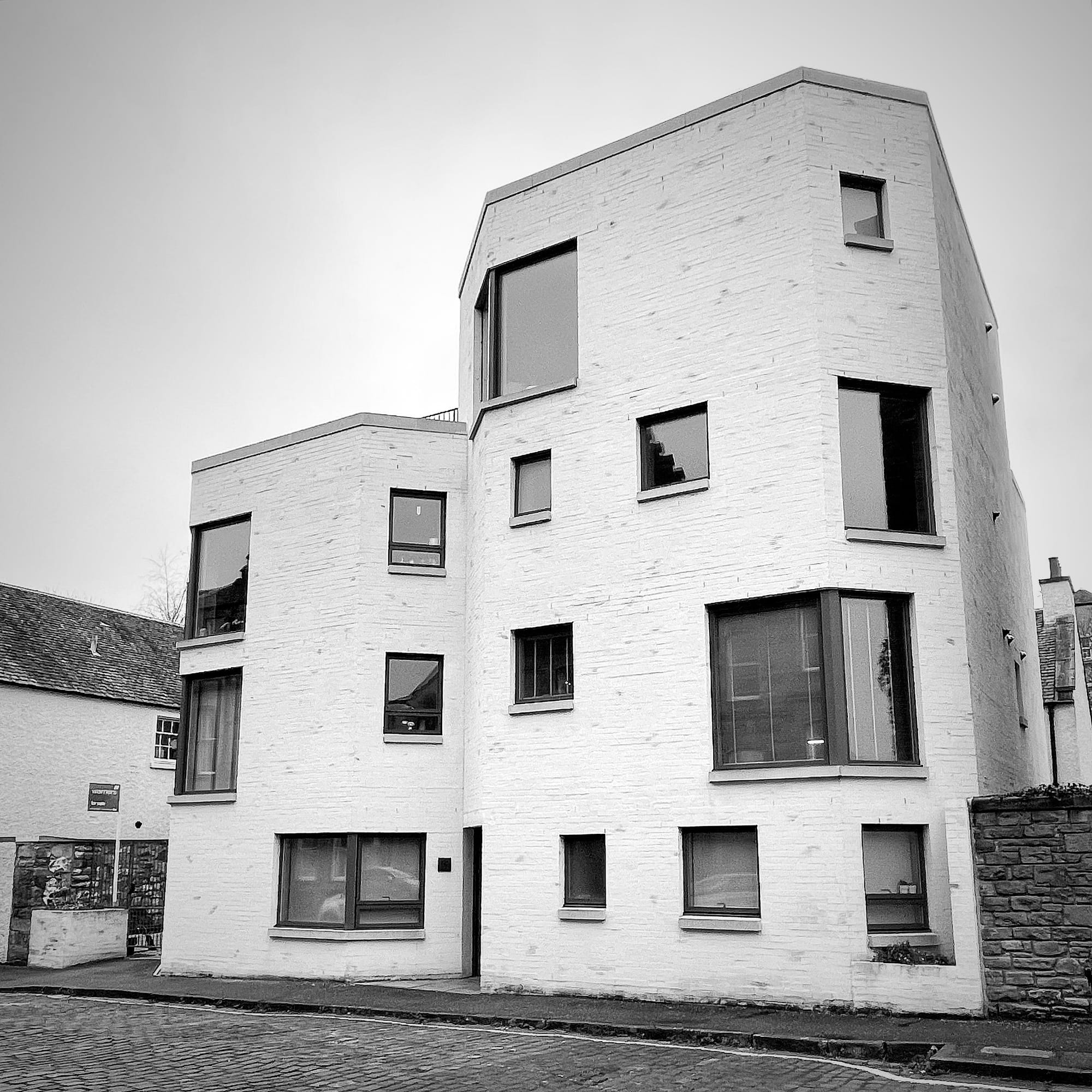
A little later in my travels, on a small historic urban square in Edinburgh I came across a small apartment building designed by Fraser/Livingstone (image below). Modest in scale, with six apartments (a distant cousin of the Australian post-war 'six-pack' of flats) Simon Square sits quietly amongst a streetscape of 19th century stone tenements. It is cleverly planned around corner bay windows that riff on their historic context, but are also amplified and arranged to make best use of the soft, grey light of Scotland. At the centre is an access stair that doubles as a place of neighbourly social encounters. The structure is cross laminated timber using local plantation softwood, with the timber exposed internally. The outer shell is brickwork with a lime slaister-coat, light in colour, that both connects with and differentiates from its neighbours. The architects make a case for a new urban vernacular, not to be confused with the London variety. As a model approach for infill housing with low embodied carbon, it is very compelling.
Each of these examples, from the Barbican to Simon Square, are attempting in their own way to make community, as much as they are housing. They contain ideas that encourage residents to feel part of a larger whole. They work with shared space in different ways to cushion private from public, finding gentle transitions rather than blunt demarcations. The exception to this might be the One Park Drive tower which retreats from its hyper-commercial context.
Similarly, a uniform fabric of bricks, render, terracotta or concrete tie everything together in each example. There is a play of forms but there is a material restraint that creates cohesion and an overall identity. In a way, they sit somewhere on a spectrum between 'background' and overtly 'iconic' architecture. They are all both inventive and contextual. Maybe there is a new way to describe this, without the baggage of 'newness' or the 'vernacular', or perhaps this is just architecture done well.