Ambiguity, Dexterity and Play
A curiosity about how things are made has been with me since starting work as an inexperienced graduate straight out of architecture school. Rooted in the necessity to learn quickly and be useful, I needed to absorb how a building is assembled and crafted from others. It instilled in me the idea that to be creative you really had to know your way around the subject, to develop a level of dexterity. Even now, I still believe that it helps to understand what you are working with before you can challenge it creatively - knowing the rules before you bend them.
However, I also realised that to do more than simply repeat, or refine, this knowledge required you to detach yourself from a linear process and allow for play. Some tension between dexterity and playfulness is necessary so that new ideas can be tested, assessed, discarded, and adopted. Those ideas may initially be clumsy or awkward. A moratorium on judgement is essential to allow them to flourish a little before being subjected to scrutiny.
Whilst in this zone between knowing your subject and mucking around with it, a new question arises - why? Why is a building organised in a particular way? Why use certain materials? Why does is it work within a particular architectural language? Why does it express its purpose in that way? The answer emerges from many iterations. By making and prototyping, questioning and wondering, it can be found. We might start with a clear purpose in mind but why we creatively respond in a certain way must be figured out. It is an ongoing back and forth, a shepherding of ideas that at some point coalesce.
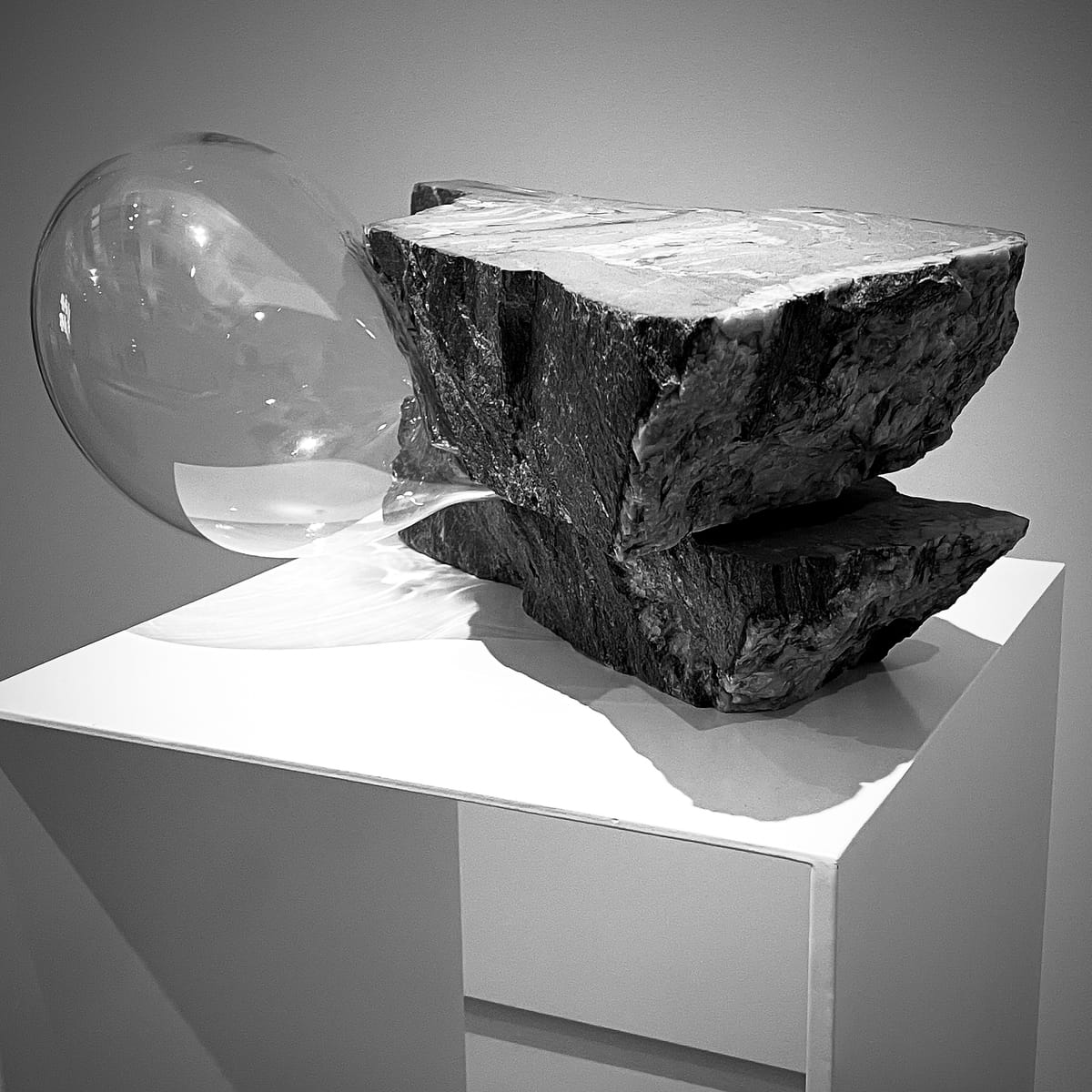
On my way driving from the city to the coast recently, I stopped off at a regional gallery for a break and came across an art work by the Australian artist Simone Slee. Whilst I don't presume to know Slee's creative process, I could imagine both the artist's expertise across mediums and their playful testing of different arrangements. However, always with intent, searching for the right expression, an exquisite tension between two forms, the weighty cragginess of Pyrenees quartz blocks and the delicate balloon of blown glass. Slee has stated she is exploring an interest in the limits of materials and the precarious moment just before failure in works like this, and yet there is an ambiguity that allows the viewer to draw their own interpretation,
Ambiguity is an interesting characteristic. It can be seen negatively, a lack of clarity. However, rather than being explicit in conveying one idea, being ambiguous to some degree allows for an open-ended interaction. Architecture can get caught up in trying to communicate overtly, when perhaps it is better to establish a framework of ideas. This allows a way in for others, rather than being hermetically sealed by the architect (or artist). It is generous as it extends the creative process, acknowledging that the meaning and value of a building inevitably continues to evolve and change over time.